Pharmacopoeia quality
Pharmacopoeia Quality
We stick to the book when it comes to quality. We test our botanicals using standard pharmacopoeia methods. And we design our processes to meet those global standards. It’s how we keep things consistent and reliable.
The pharmacopoeias provide the herbal industry with objective, transparent, scientifically validated methods for demonstrating quality. They represent the best collective knowledge available for ensuring botanicals are what we say they are, contain what we claim they contain, and are safe for human consumption. The USP (United States Pharmacopoeia), European Pharmacopoeia, British Pharmacopoeia, and Ayurvedic Pharmacopoeia of India all publish specifications or monographs for herbs. If an ingredient doesn’t meet these specs, we work to understand why not.

Why this matters
Suppliers often claim their herbs are 100% pure. They provide certificates to prove it. But we always ask: did they actually run the tests? And what methods did they use?
We see issues more often than you might expect. We have found high Withanolide Ashwagandha powder that was actually mixed with leaf powder instead of just root to spike the numbers. We have seen Turmeric powder containing artificial color or curcuminoids. Often the botanicals that look fine, fail when we examine them under a microscope or run a chemical analysis.
This is exactly why pharmacopoeias exist. They provide the standard testing methods to catch these shortcuts. By following them, we don’t have to rely on trust. We can verify exactly what is in the bag.
How we test
Every batch goes through four types of testing:
1. Identity: Is it the right plant?
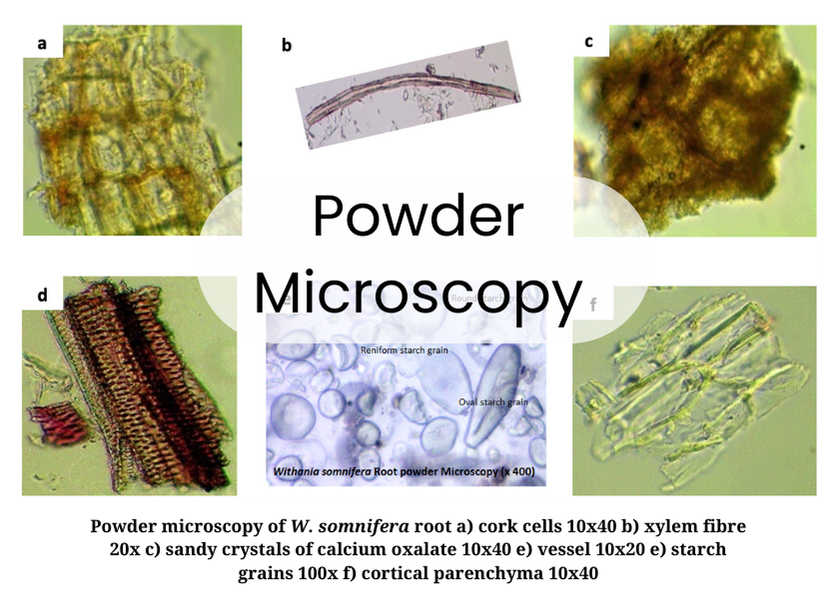
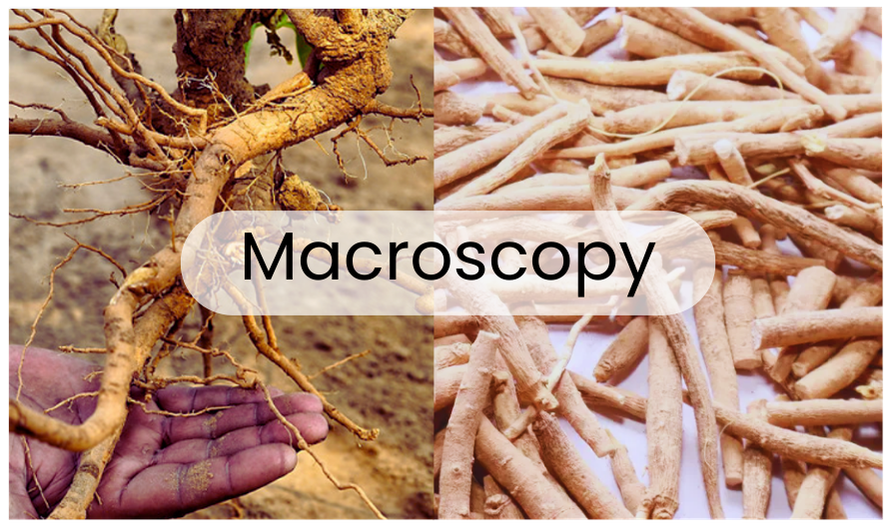
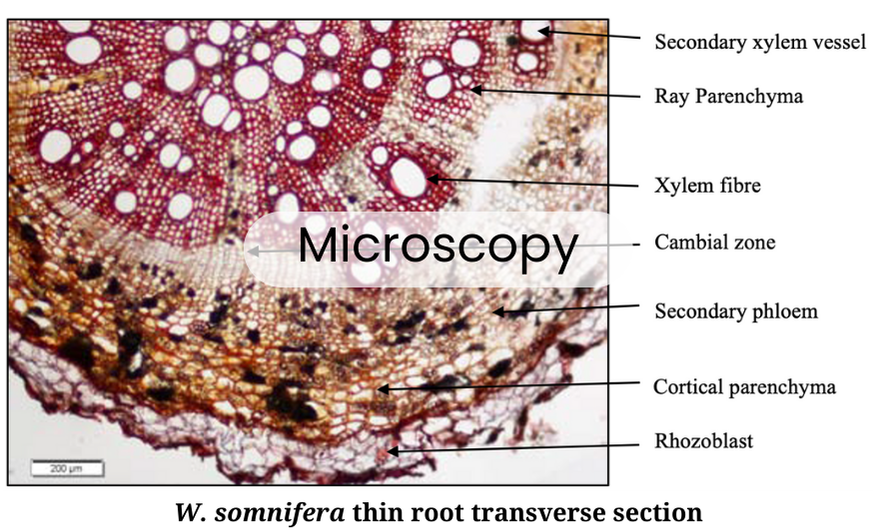
We establish botanical identity through a tiered approach, starting with Macroscopic Identification. Whole herbs undergo morphological assessment, where physical traits are cross-referenced with Pharmacopoeial standards. Microscopic Evaluation follows this; we use both tissue sectioning and powder microscopy, we analyze diagnostic characters such as trichomes, stomata, and cell inclusions.
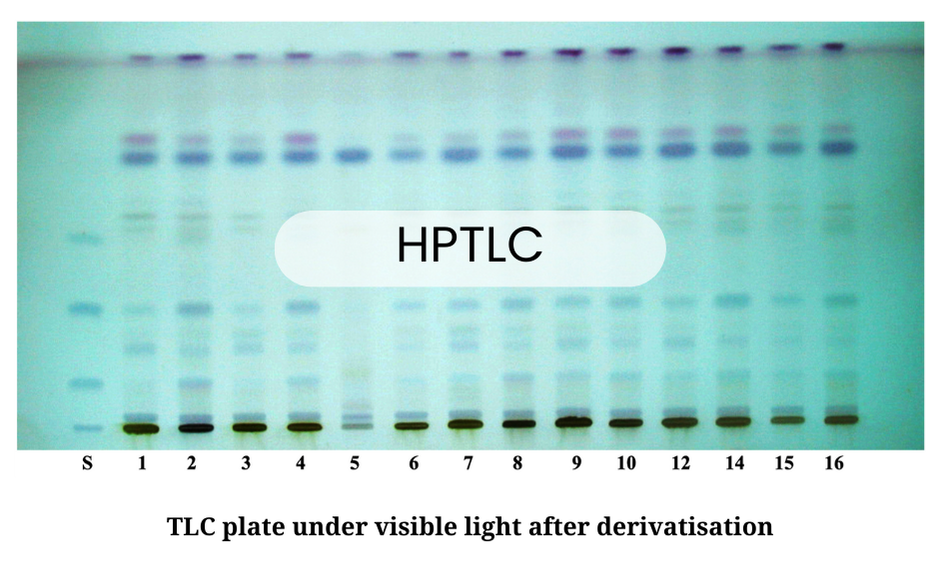
The final confirmation is achieved via HPTLC (High-Performance Thin-Layer Chromatography). By chromatographically separating the plant’s compounds, we obtain a unique chemical fingerprint. This profile is compared against a certified reference standard, ensuring that any deviation, indicating species substitution or adulteration, is immediately identified.
Our Lab
We operate in an ISO 17025-accredited laboratory. That means our testing methods are validated, and our results are recognized by regulatory bodies worldwide.
Most suppliers send samples to outside labs and wait weeks for results. We run our own tests. This gives us faster answers and better control over quality.
One Standard for All Markets
Different countries use different pharmacopoeias. The US focuses on identity testing. Europe emphasizes purity. India includes traditional preparation methods.
Instead of creating different versions of each herb for different markets, we try to aim for the strictest requirement from any pharmacopoeia.
This means one batch can go to customers in the US, Europe, or Asia. You don’t need separate suppliers for different regions.
2. Quality: Does it have the right compounds?
We measure the marker compounds that are unique to each herb. We quantify the amounts using HPLC analysis.
For example:
- Ashwagandha: minimum 0.3% w/w withanolides (the specific ones defined by USP)
- Turmeric: minimum 1.5% w/w curcuminoids
- Brahmi: minimum 1.5% w/w bacosides
- Gotu Kola: minimum 0.75% w/w triterpenes
They’re based on pharmacopoeia standards and clinical research.
3. Purity: Is it clean?
We test every batch for:
- Pesticide residues (against European limits, which are stricter than most regions)
- Heavy metals (lead, cadmium, mercury, arsenic)
- Mycotoxins (from fungal contamination)
European Pharmacopoeia sets some of the toughest purity standards in the world. We try to use those as our baseline.
4. Safety: Is it free from pathogens?
Many sterilization methods: irradiation, ethylene oxide are prohibited under organic standards or consumer-rejected. We’ve developed processing protocols that achieve microbial compliance through:
- Source material selection and proper drying at source (sun or covered shade)
- Cold storage of fresh material followed by timely processing to minimize microbial proliferation
- 3rd-party validated microbicidal treatments compatible with organic certification
- R&D backed heat treatment that is unique to each herb.
Target: Total Aerobic Microbial Count <10⁴ CFU/g, pathogens absent.
Setting Standard for Quality
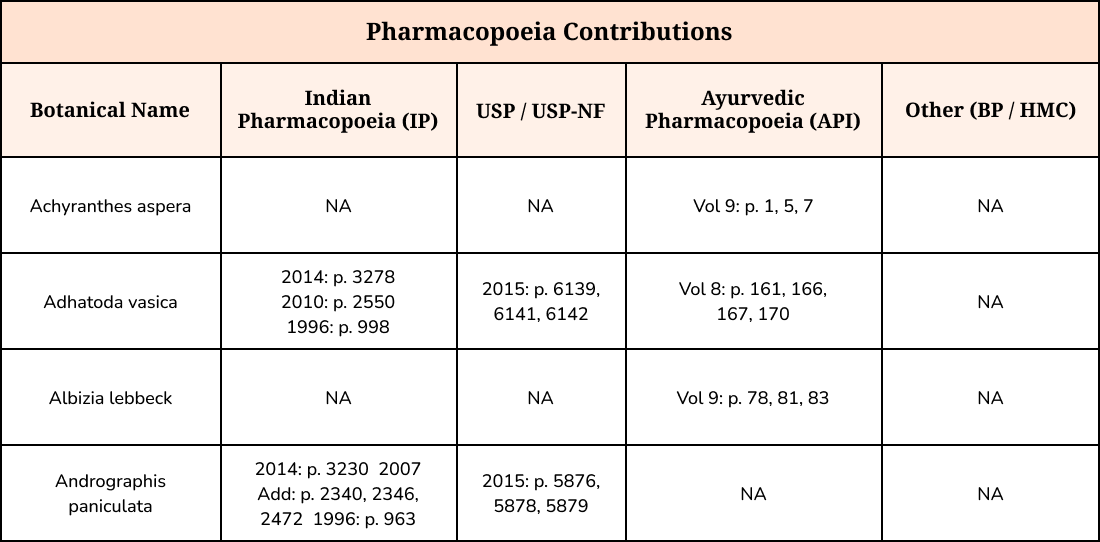
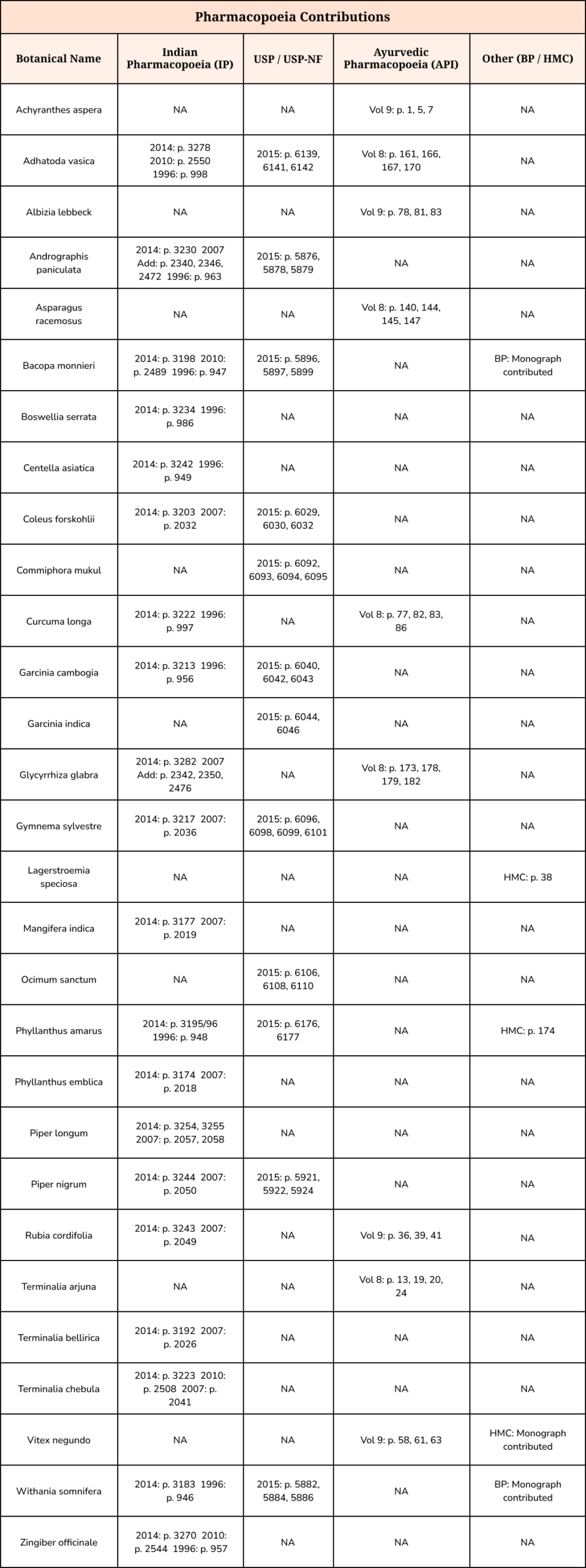
This table summarizes the analytical monographs contributed by our team to the Indian Pharmacopoeia (IP), United States Pharmacopoeia (USP), Ayurvedic Pharmacopoeia of India (API), and others.
Pharmacopoeia Contributions
Botanical Name
Indian Pharmacopoeia (IP)
USP / USP-NF
Ayurvedic Pharmacopoeia (API)
Other (BP / HMC)
Achyranthes aspera
NA
NA
Vol 9: p. 1, 5, 7
NA
Adhatoda vasica
2014: p. 3278 2010: p. 2550 1996: p. 998
2015: p. 6139, 6141, 6142
Vol 8: p. 161, 166, 167, 170
NA
Albizia lebbeck
NA
NA
Vol 9: p. 78, 81, 83
NA
Andrographis paniculata
2014: p. 3230 2007 Add: p. 2340, 2346, 2472 1996: p. 963
2015: p. 5876, 5878, 5879
NA
NA
Pharmacopoeia Contributions
Botanical Name
Indian Pharmacopoeia (IP)
USP / USP-NF
Ayurvedic Pharmacopoeia (API)
Other (BP / HMC)
Achyranthes aspera
NA
NA
Vol 9: p. 1, 5, 7
NA
Adhatoda vasica
2014: p. 3278 2010: p. 2550 1996: p. 998
2015: p. 6139, 6141, 6142
Vol 8: p. 161, 166, 167, 170
NA
Albizia lebbeck
NA
NA
Vol 9: p. 78, 81, 83
NA
Andrographis paniculata
2014: p. 3230 2007 Add: p. 2340, 2346, 2472 1996: p. 963
2015: p. 5876, 5878, 5879
NA
NA
Bacopa monnieri
2014: p. 3198 2010: p. 2489 1996: p. 947
2015: p. 5896, 5897, 5899
NA
BP: Monograph contributed
Boswellia serrata
2014: p. 3234 1996: p. 986
NA
NA
NA
Centella asiatica
2014: p. 3242 1996: p. 949
NA
NA
NA
Coleus forskohlii
2014: p. 3203 2007: p. 2032
2015: p. 6029, 6030, 6032
NA
NA
Commiphora mukul
NA
2015: p. 6092, 6093, 6094, 6095
NA
NA
Curcuma longa
2014: p. 3222 1996: p. 997
NA
Vol 8: p. 77, 82, 83, 86
NA
Garcinia cambogia
2014: p. 3213 1996: p. 956
2015: p. 6040, 6042, 6043
NA
NA
Garcinia indica
NA
2015: p. 6044, 6046
NA
NA
Glycyrrhiza glabra
2014: p. 3282 2007 Add: p. 2342, 2350, 2476
NA
Vol 8: p. 173, 178, 179, 182
NA
Gymnema sylvestre
2014: p. 3217 2007: p. 2036
2015: p. 6096, 6098, 6099, 6101
NA
NA
Lagerstroemia speciosa
NA
NA
NA
HMC: p. 38
Mangifera indica
2014: p. 3177 2007: p. 2019
NA
NA
NA
Ocimum sanctum
NA
2015: p. 6106, 6108, 6110
NA
NA
Phyllanthus amarus
2014: p. 3195/96 1996: p. 948
2015: p. 6176, 6177
NA
HMC: p. 174
Phyllanthus emblica
2014: p. 3174 2007: p. 2018
NA
NA
NA
Piper longum
2014: p. 3254, 3255 2007: p. 2057, 2058
NA
NA
NA
Piper nigrum
2014: p. 3244 2007: p. 2050
2015: p. 5921, 5922, 5924
NA
NA
Rubia cordifolia
2014: p. 3243 2007: p. 2049
NA
Vol 9: p. 36, 39, 41
NA
Terminalia arjuna
NA
NA
Vol 8: p. 13, 19, 20, 24
NA
Terminalia bellirica
2014: p. 3192 2007: p. 2026
NA
NA
NA
Terminalia chebula
2014: p. 3223 2010: p. 2508 2007: p. 2041
NA
NA
NA
Vitex negundo
NA
NA
Vol 9: p. 58, 61, 63
HMC: Monograph contributed
Withania somnifera
2014: p. 3183 1996: p. 946
2015: p. 5882, 5884, 5886
NA
BP: Monograph contributed
Zingiber officinale
2014: p. 3270 2010: p. 2544 1996: p. 957
NA
NA
BP: Monograph contributed
Ashwagandha ID manual
As an example, we have published this identification manual. Submit your details to access the full document.

Why we do this
The botanical ingredients industry is characterized by inherent variability, inconsistent regulations, and trust deficits. In this landscape, the pharmacopoeia offers much-needed objectivity.