
Why Cardamom Costs What It Does
Three years before the first harvest, near-monthly organic spraying and five to seven rounds of hand-picking. Here's where the money goes.
- ~3 years
- before a commercially viable harvest
- 5–7
- hand-picking rounds a season
- ~13
- organic spray rounds a year
- 54%
- of annual labor cost goes on harvesting
At a glance
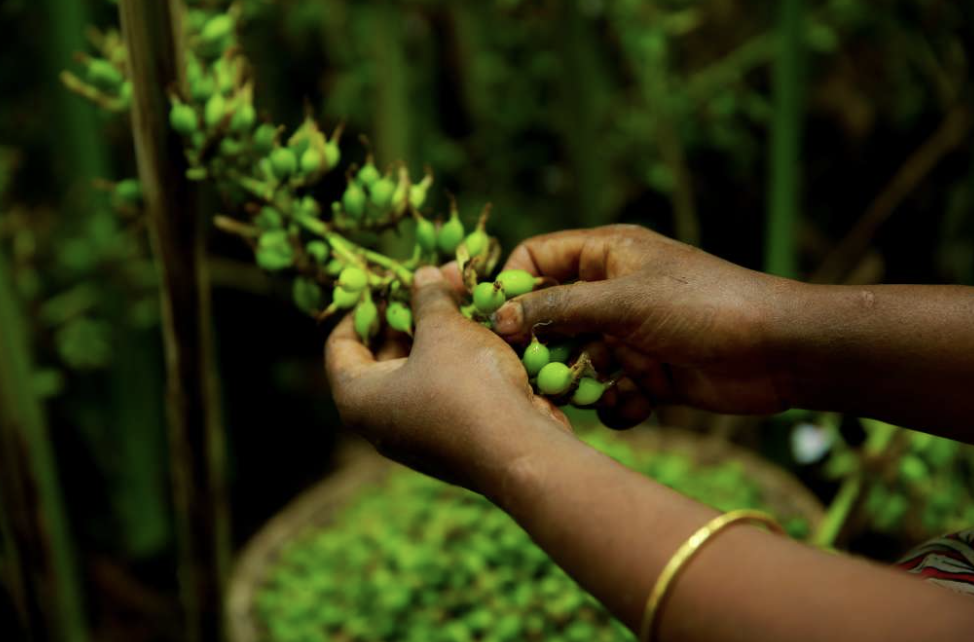
High in the shaded slopes of the Western Ghats, cardamom harvest depends on color. A picker walks the same row of plants every few weeks, checking each pod. Not ripe enough, and the flavor never develops; too ripe, and the pod splits and the crop is wasted. Get it right, and you've picked one pod. There are millions more to go, across a season that runs from July to March.
Cardamom is often called the "Queen of Spices." Most of what earns it that name has nothing to do with flavor — it's one of the hardest botanicals in the world to bring to market, and almost none of that difficulty shows once the pod reaches a buyer's warehouse.
3 long years before the first harvest
Cardamom won't grow just anywhere. It needs the specific shaded, high-altitude, high-humidity conditions found in places like Kerala's Idukki district — forest-canopy cover, consistent rainfall, and cool temperatures that few other cash crops tolerate. Get the altitude or shade wrong and the plant simply won't thrive.
Even in the right conditions, a cardamom plant needs about three years before it produces a commercially viable harvest.1 For three years, a farmer is paying for land, labor, and care with no income from the crop at all.
And the plant needs watching the entire time. Thrips are the most persistent pest, altering pod quality if left unchecked. Viral diseases — locally known as Katte and Nilgiri necrosis — stunt growth and spread through a plantation.2 A fungal pod rot has also shown up in recent years. Keeping all of this in check takes roughly monthly spraying, about 13 rounds a year, for the life of the plant.3
The intensive labor
Cardamom pods on the same plant don't ripen together. That's the root of everything that makes harvest so demanding: there's no single picking day. Instead, workers return to the same plants five to seven separate times across the season, roughly 30 to 60 days apart, hand-selecting only the pods that have reached the right stage - seeds browning inside, skin still green outside. Nothing about that can be mechanized. It takes a trained eye and a light hand.
Nothing about that can be mechanized. It takes a trained eye and a light hand.
That repetition adds up to numbers on the ground: a single picking round on one farm can call for 30 to 75 laborers at once.3 Multiply that by five to seven rounds, spread across nine months, and cardamom asks for more sustained hand labor than almost any other spice crop grown in India.
Who does that labor is changing, too. Cardamom-growing regions in Kerala have historically drawn on local Tamil Nadu workers, but the workforce has shifted; an estimated 60% of pickers today are migrant laborers from further north in India, often working longer hours for less pay than the workers they've replaced.3 And the work is at the mercy of the weather in a way office work never is: monsoon flooding has caused documented stretches of a month or more where picking simply stops, because the plantations are inaccessible or the crop can't be handled safely.
Where the money actually goes
On a documented cardamom farm in Idukki, harvesting alone accounted for 54% of the entire annual labor cost (roughly ₹1,25,000 out of ₹2,29,000 per acre, per year).3 Not planting, weeding nor fertilizing. Just the act of walking the rows, again and again, picking by hand.
Annual labor cost on a cardamom farm in Idukki
Per acre, per year · total ₹2,29,000
Source: Jegadeesan & Miyazaki (2025).3
This number explains most of what drives cardamom's price. The crop's biggest cost is the sustained, skilled human labor with no mechanized shortcut, and there's no way to bring the cost down.
What we are paying for
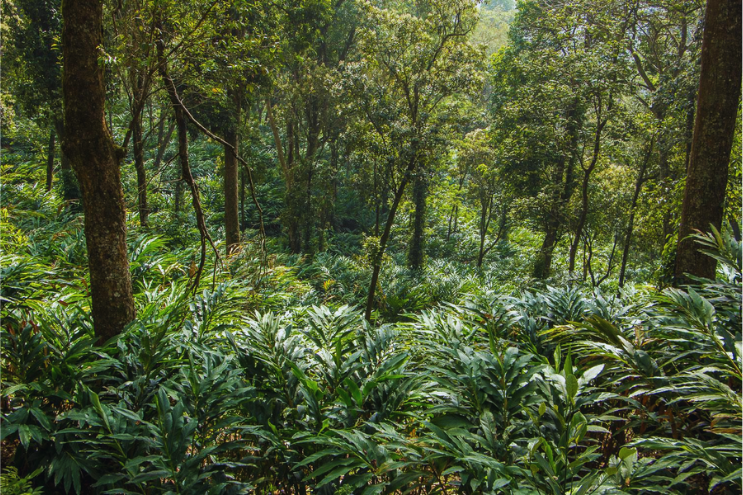
Three years of care before the first harvest. Nearly monthly spraying to keep disease in check. 5-7 separate picking rounds a season, each one asking dozens of workers to make the same judgment call, pod by pod, for months on end. None of it can be rushed, and very little of it can be automated.
That's what actually sits behind cardamom's price: three years of unpaid growing time, near-monthly organic pesticide spraying, and hand labor that eats more than half the annual budget. It is just the direct cost of getting this spice off the plant!
How we source cardamom
Our organic cardamom comes from smallholder farms in the Western Ghats, where families hand-harvest shade-grown pods. Cardamom's aroma fades with air exposure, so we handle it carefully and pack it tight.
- Whole
- Coarse cut
- Granules
- Tea bag cut
- Powder
Certified USDA Organic, India Organic, Canada Organic and Rainforest Alliance.
View cardamom specificationsSources
- Spices Board India. Cost of Cultivation of Cardamom (Kerala). Yield table, years 2–3.
- Spices Board India (2020). Plant Protection Code for Small Cardamom.
- Jegadeesan, M. & Miyazaki, H. (2025). Cardamom cultivation in Idukki, India: Practices, challenges, and historical insights. International Journal of Horticulture and Food Science, 7(1), 82–88.
Keep reading
When the Soil Comes Back to Life
The science, economics and common sense behind organic farming, from farmers who made the switch.
Our ICS Group
Meet the farmer group we work with on organic chamomile.
Cinnamon Tea
The history and flavor of cinnamon, and what to look for in quality.